
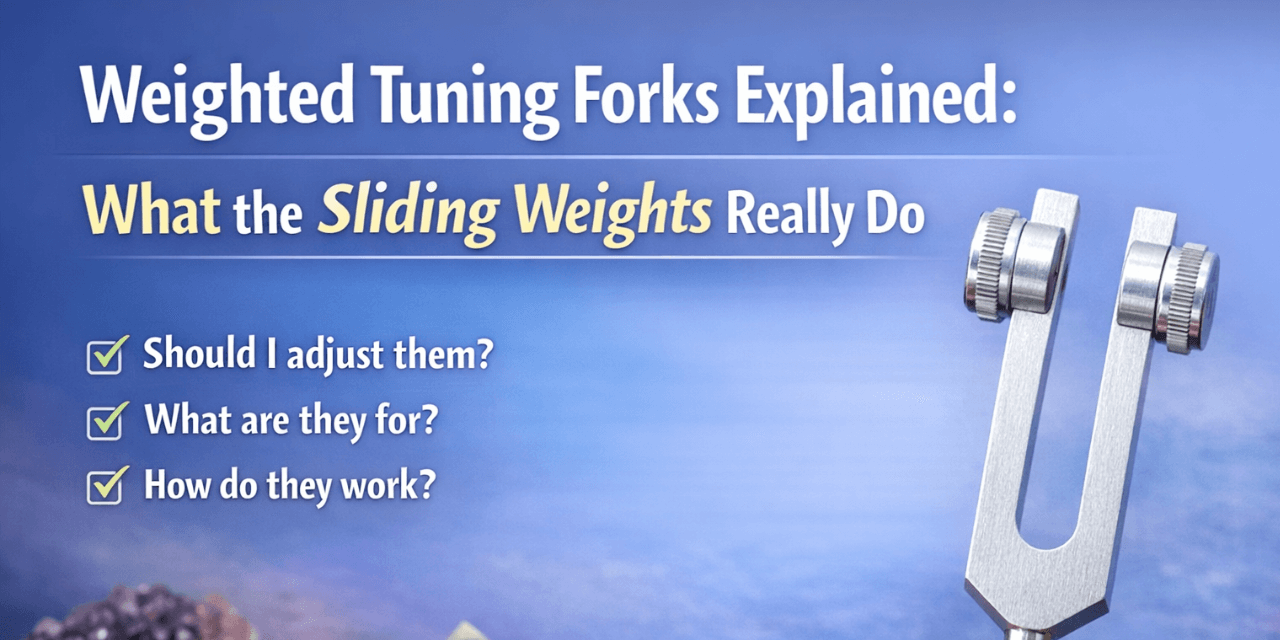
As you will notice in this blog, I tend to move between different worlds that resonate with me, from the personal to the meditative, passing through different phases and teachings that have shaped my own journey. Today I want to talk about weighted tuning forks, because they create many questions. They usually come with a small tool to adjust the weights, and naturally people wonder: should I adjust them or not, what are they really for, and what happens when that small piece moves up or down? In this article, we will clarify everything in a simple and grounded way, so any reader looking for reliable information can leave with a clear understanding of how weighted tuning forks really work.
What is a weighted tuning fork
A weighted tuning fork is a tuning fork that has small cylindrical weights attached near the tips of the prongs. This simple design change creates important physical effects. From an acoustics point of view, adding mass at the ends increases mechanical vibration through the body, the vibration is felt more strongly on contact, and the sound in the air usually lasts less time than an unweighted fork. Because of this, weighted tuning forks are commonly used in bodywork, clinical vibration testing, and sound therapy applications where physical transmission matters more than long audible sustain. Unweighted forks, on the other hand, are usually preferred when the goal is longer sound in the air or more subtle energetic work.
Why the sliding weights exist (the real physics)
To understand the purpose of the sliding weights, it helps to know how a tuning fork vibrates. A tuning fork works as a U-shaped elastic oscillator whose main frequency depends mostly on the length of the prongs, the material of the metal, and the thickness and stiffness. When small masses are placed near the tips, the effective mass at the point of maximum movement increases, mechanical energy transfers more efficiently into the body, and the vibration feels stronger but usually decays faster in the air. This is why weighted forks are often chosen for direct body application. It is important to understand that the engraved frequency is mainly determined by the fork’s geometry. Small adjustments of the weights usually do not create a meaningful change in pitch, although extreme changes can slightly affect the vibrational behavior.
Should you adjust the weights
For most users, the honest answer is simple. It is usually best to leave the weights in their factory position. Quality manufacturers place the weights where the fork performs optimally, and the adjustment feature exists for fine control, not because constant adjustment is required. If you are new to tuning forks, keeping the original position is the safest and most reliable choice.
What happens if you move the weights toward the tips
When the weights sit closer to the ends of the prongs, the tactile vibration becomes stronger, the mechanical impact on the body increases, the sound in the air becomes slightly shorter, and the fork feels more grounding in practice. This position is often useful for muscle work, joint application, dense tissue areas, and situations where strong somatic feedback is desired.
What happens if you move the weights toward the base
When the weights move closer to the stem, the tactile intensity becomes softer, the fork rings a bit longer in the air, the mechanical feel is gentler, and the vibration feels more subtle on the body. This can be helpful for very sensitive individuals, gentle nervous system work, bony or delicate areas, and softer therapeutic sessions.
Important safety guidelines
To keep your tuning fork working properly, always keep both weights perfectly symmetrical, do not remove the weights unless the manufacturer allows it, avoid large or uneven adjustments, use the adjustment tool gently, and remember that small weight changes mainly affect feel, not the core frequency. Even small asymmetries can create unstable vibration patterns, so careful handling matters.
Weighted vs unweighted tuning forks
Understanding this difference removes most confusion. Weighted tuning forks are best when you want direct body contact, strong tactile feedback, work on muscles or joints, a grounding effect, or shorter but deeper vibration. Unweighted tuning forks are better when you work in the energy field, want long resonance in the air, do meditation sound work, or prefer subtle auditory effects. Both tools are valuable and simply serve different purposes.
Conclusion
Weighted tuning forks are designed to improve how vibration is transmitted into the body through added mass at the tips. The sliding weights are not mainly for retuning the frequency, but for fine control of the vibrational feel and mechanical impact. For most practitioners, leaving the weights in their factory position will provide the most balanced and reliable performance. With proper understanding and careful handling, weighted tuning forks become precise tools for delivering focused mechanical vibration exactly where it is needed.