
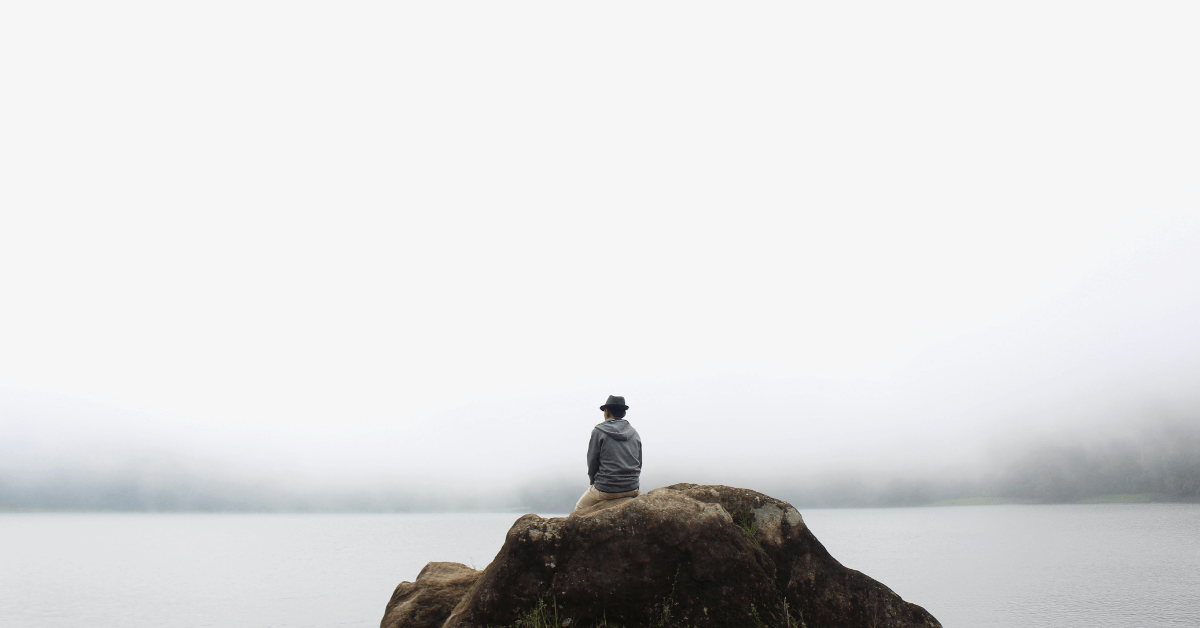
For a long time, I moved through life without giving much importance to my thoughts. They were simply there, automatic, invisible, a natural part of being human. Our evolution and intelligence have gifted us the ability to think, to anticipate, to plan, and ultimately, to survive. Thanks to this capacity, we are still here today.
But something shifts when that very same gift turns against us. I remember all the times I sabotaged myself, all the moments when my perception of reality — built entirely inside my head — pushed me toward conclusions that were not necessarily true. Anthony de Mello once said: «Suffering exists when you identify with what you think rather than with who you are.» Those words resonated with me deeply, because I had spent years believing my thoughts to be absolute truth.
Modern science is now confirming what sages have been saying for centuries: our thoughts are not just ephemeral clouds passing through the mind — they have measurable effects on the body. Research in psychoneuroimmunology has shown that chronic negative thinking and stress can suppress immune function, increase inflammation, and alter hormonal balance. Harvard studies have demonstrated that practicing mindfulness can actually rewire neural pathways and reduce activity in the amygdala, the part of the brain responsible for fear responses.
Dr. Candace Pert, a neuroscientist known for her work on neuropeptides, described emotions as «molecules of emotion» that literally communicate with every cell in the body. This means that what we think and feel is not just in our head — it is chemically echoed throughout our entire organism.
The problem is that we perceive only a tiny fraction of reality. Neuroscience reminds us that our senses process a very narrow band of the electromagnetic spectrum, and quantum physics has shown us that the observer is not separate from what is observed. Still, we take that fragment of perception as the ultimate reality. We build entire stories out of it. And we defend them fiercely.
I can recall countless moments when I was in love with my analysis — when I believed that thinking more would eventually bring me peace. But every conclusion I reached left me unsettled, pushing me toward yet another loop of reasoning. Until one day I finally said to myself: I would rather have peace than be right.
And then a question arose: What if I was wrong?
If I was wrong, it was the sweetest mistake of my life, because it brought me back to the present. I sat with it, looked it in the eye, and realized I was living the most miraculous experience — not with my senses, but with my heart.
Rumi whispered across centuries: «Try to accept the changing seasons of your soul, even the winters, for they clear the way for new springs.» I understood then that I was not a random occurrence. The universe is precise, measured, harmonious — and so am I. And so are you.
Anthony de Mello invites us: «Teach what you love, and what you love will teach you.» I have seen this unfold in my life again and again.
As a Westerner, I had always been trained to mask death, to treat it as something tragic or far away. We plan, we calculate, we project, rarely stopping to appreciate the grand design that we are part of. The circumstances may not always look perfect to the mind, but they are still here, still holding us.
What has been the most challenging for me is trust. Life kept repeating to me like a mantra: Trust. And I resisted, because trusting felt like stepping into a space with no ground beneath me. But slowly, I am becoming someone who trusts with her entire heart — not blindly, but with awareness.
Perhaps the greatest act of faith is to let go of control and allow life to flow through you. Physics teaches us that particles can be waves, and that uncertainty is not a flaw but the foundation of reality. Maybe the same applies to us: we are not meant to know it all, we are meant to experience.
Today, I choose to live in that experience, with all its uncertainty, knowing that every breath is a miracle, every thought an invitation — and that I am far more than the stories in my head.