
When we approach sound as a path of healing, the most important thing is not only the frequency itself, but the intention behind it. A tuning fork is not just a metal instrument that vibrates; it is an extension of our own consciousness, a bridge between the physical and the subtle. To use it properly, we must prepare both — the hand that holds it and the mind that guides it.
The mindset before sound
Just like meditation, the first encounters with a tuning fork can feel restless. We live surrounded by noise — not only external noise, but the endless dialogue of our own thoughts. When I began meditating, I could not hold silence for more than a few seconds. Every attempt to relax brought an avalanche of tasks, memories, and judgments.
It took me time to understand that I could train my mind to serve me, instead of letting it run wild against me. It was a process of reclaiming inner sovereignty — the moment I realized that silence is not something we find, but something we create.
Establishing a ritual made the difference. Choosing a time when no one would interrupt me. At least twenty minutes of presence. Phone out of reach, the room in silence. A few deep breaths to prepare the body, and then — to be inside it. To feel what it feels.
The ritual of connection
Before activating a tuning fork, take a few moments to ground yourself. Breathe deeply. Observe the sensations in your body. You are not just about to make a sound; you are about to open a dialogue with your own energy field.
In my personal journey, I have often felt a knot in my chest — a persistent blockage around the heart chakra (Anahata), the energetic center that governs compassion, love, and emotional openness. That is why I chose to include the 528Hz tuning fork, known as the frequency of the heart, in my set.
When I enter silence, thoughts still appear, but I no longer identify with them. I observe them pass like clouds, while I stay grounded in my breath, listening to my heartbeat and the living vibration that animates this body. It is then, in that presence, when I take the tuning fork.
I activate it gently and bring it close to the space in front of my chest, without touching the body. I focus on the knot, on the sensation that has been there for so long. The sound begins to weave through the tension — not as magic, but as vibration. The body listens even when the ears do not. Little by little, that tightness melts into sound.
Weighted and unweighted tuning forks
There are two main types of tuning forks — weighted and unweighted.
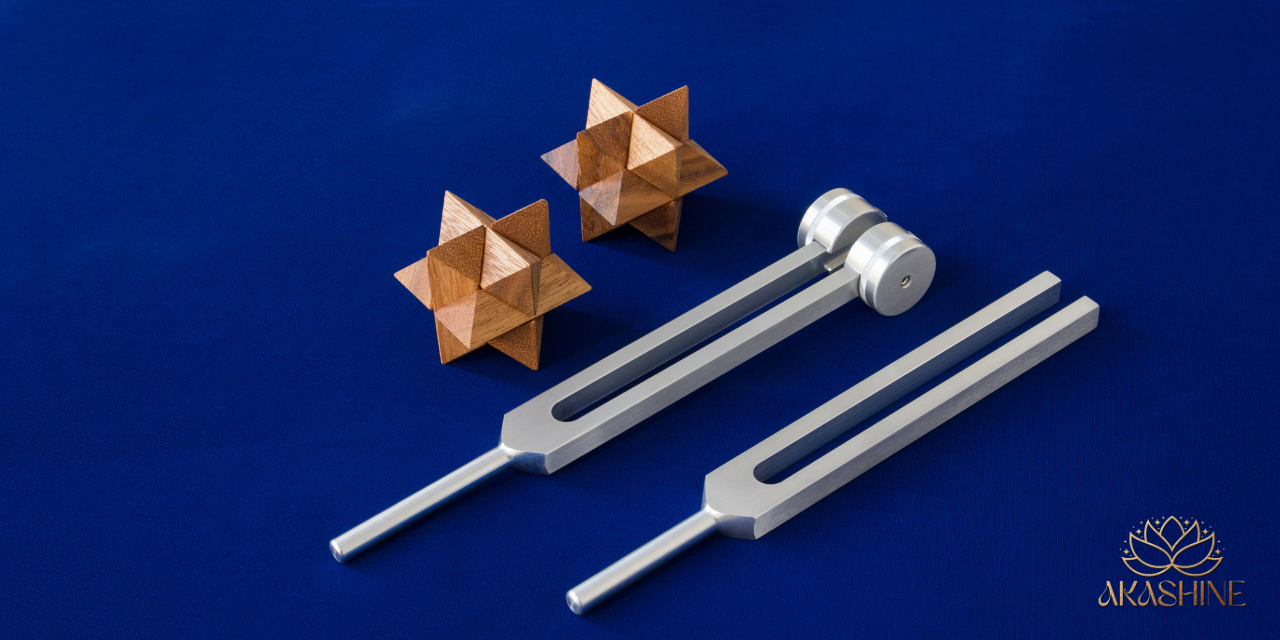
Weighted tuning forks, also called osteophonic forks, have small discs at the end of each prong. These weights allow the vibration to travel more deeply through the metal and into the body. They are perfect for physical applications, such as bones, muscles, and joints. When placed on the body, they transmit their vibration directly through the tissues, enhancing circulation and relaxation.
Unweighted tuning forks, on the other hand, are used for energetic work. Their vibration travels mainly through sound — the frequency enters through the auditory system, stimulates the vagus nerve, and reaches the brain. Scientific studies have shown that specific frequencies can influence brainwave patterns, helping to synchronize hemispheric activity and induce states of calm and coherence.
The science of vibration
Modern research has begun to confirm what ancient traditions always knew — that sound affects matter. Studies in vibroacoustic therapy, for instance, show how low-frequency sound waves can influence muscle tone, blood flow, and even emotional regulation through the parasympathetic nervous system.
What is undeniable is the body’s sensitivity to vibration. Every cell in our organism resonates; every organ has its own natural frequency.
When we introduce a tuning fork with intention and presence, we are not forcing the body to change — we are reminding it of its natural rhythm.
The union of science and spirit
The use of tuning forks stands at a beautiful crossroads between science and spirituality. They are both precise acoustic instruments and tools of consciousness. When we bring intention to sound, when we create a sacred space to listen — truly listen — we are engaging in a process of realignment.
I love to share my own experience because I am no different from you. If I was able to find peace and coherence through sound, you can too. This is not about perfection, but about returning — again and again — to the simple awareness that we are vibration, and that every sound we create shapes the world inside and around us.