
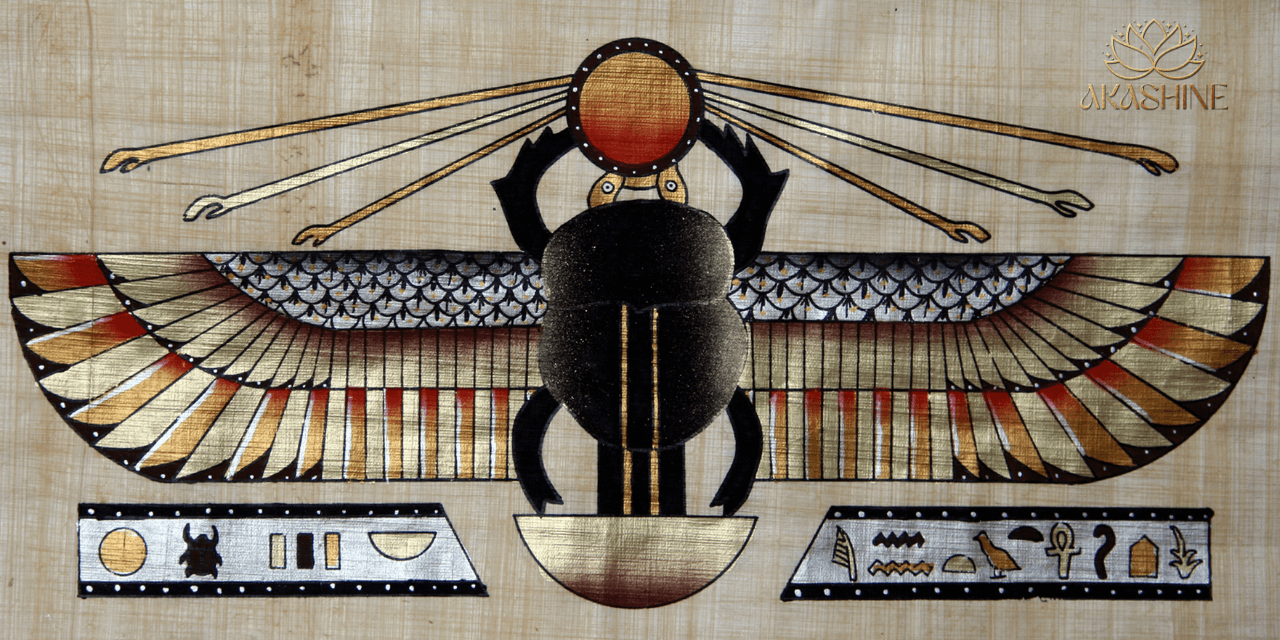
The scarab that returned through time
Many years ago, during a visit to my mother, she gave me several objects she no longer used, something she often does, and among them there was a small blue-silver scarab pendant that seemed insignificant at the time, so I placed it in a corner of my closet and forgot about it, unaware that the symbol would accompany me far more quietly and persistently than I could recognize then.
Years later, long after the pendant had faded into the background of my life, I felt a strong and unexplainable impulse to tattoo a scarab on the back of my neck, drawn to the Egyptian myth of the dung beetle pushing the sun across the sky, fascinated by how our ancestors created stories to illuminate the mysterious forces shaping existence, and although today we rely on physics and mathematics, I have always believed that losing the capacity for wonder is losing a vital dimension of life.
I did not choose the tattoo because of the pendant—they were separated by years—but during one of the most challenging periods of my life, after moving to another country and descending into what I can only describe as a long night of the soul, I found myself reading Jung and encountered the famous story of the golden scarab, the synchronistic moment that broke through the defenses of one of his patients.
Something inside me shifted.
I opened my closet almost instinctively, searching for the forgotten pendant, touched its cold metal, then reached for the tattoo on my neck, realizing with a stunned and breathless clarity that the symbol had been with me all along, weaving itself through my life before I had the language or awareness to understand its presence.
Synchronicity, Peat, and the deeper order behind coincidence
Not wanting to rely solely on mystical interpretations, I began searching for frameworks that honored the strangeness of the experience without dismissing it, and that is how I found the work of physicist David Peat, deeply influenced by David Bohm.
Peat proposed that synchronicities may arise from an underlying order of reality, a subtle background that is neither purely mental nor purely physical but something more unified, and he suggested that these events are not messages, nor magic, nor disguised causality, but brief openings—fault lines in ordinary life—through which we glimpse a deeper coherence between inner and outer worlds.
In that view, a symbol does not pursue us, nor do we conjure it arbitrarily; instead, both the symbol and our encounter with it unfold from the same hidden pattern, a pattern rarely visible except in moments of alignment that feel impossible to rationalize yet undeniably real.
The beauty of unanswered questions
This entry does not aim to provide instructions or conclusions, because answers tend to collapse possibilities, while questions expand them, and perhaps that is where the true beauty lies: in remaining open enough to let meaning reveal itself slowly.
So maybe the most meaningful question we can carry is this: to what extent do we shape our reality, and to what extent does reality shape us, and could both movements be part of the same deeper coherence unfolding through us in ways we only notice when we become still enough to perceive them?