
Many people use tuning forks without realizing that the way they activate them completely changes the experience.
It is not just the sound, it is how the vibration begins.
When you strike a tuning fork, you are transferring energy. That energy determines how strongly it starts vibrating and how that vibration will travel, whether through the air or through the body.
This is why there are two types of activators.
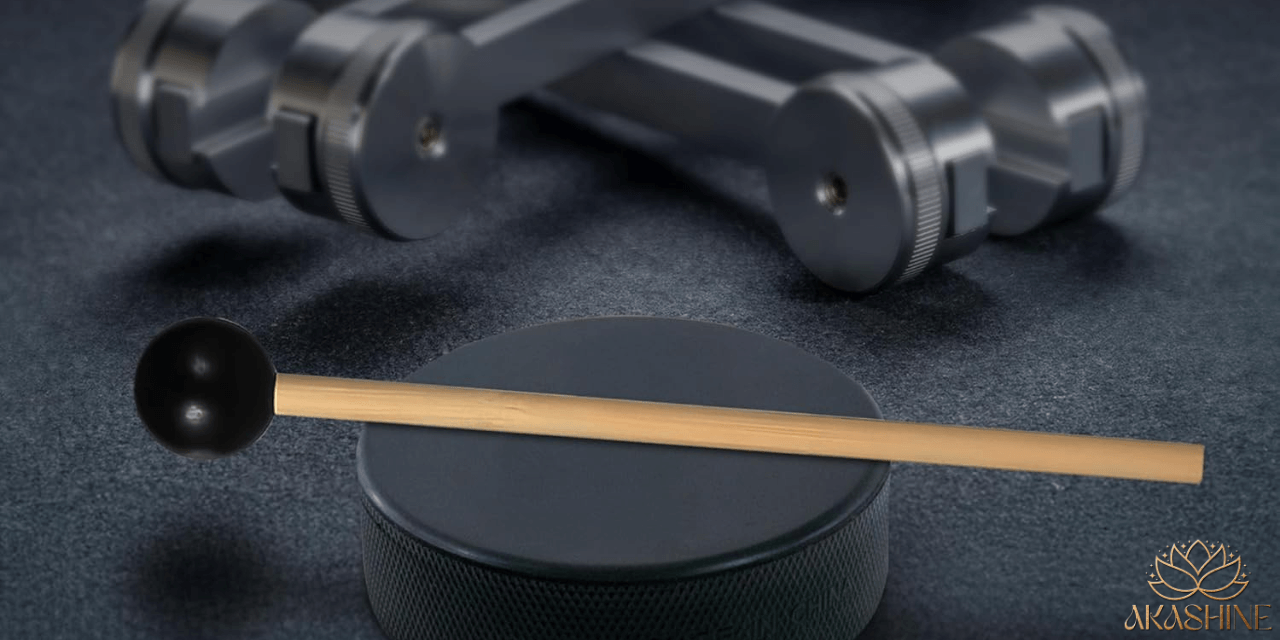
The soft approach: the rubber puck
The rubber puck softens the impact because it absorbs part of the energy when the tuning fork is struck.
This allows the vibration to begin in a more stable and gradual way. From a physics perspective, the initial amplitude of the wave is lower, which creates a smoother and less abrupt signal.
The result is a vibration that the body perceives as gentler, making it easier to relax. The nervous system tends to interpret this type of input as safe, which can help reduce activation and support a calmer state.
Use the puck when:
- You want to relax
- You are looking for a soft and stable vibration
- You are working around the body
The direct approach: the mallet
The mallet transfers more energy at the moment of impact.
This causes the tuning fork to vibrate with greater amplitude from the start, creating a stronger signal. In physics, a higher amplitude means more energy in the wave, which allows it to travel more effectively through a medium such as the body.
As a result, the vibration is more noticeable and can reach deeper when applied to muscles or joints.
Use the mallet when:
- You are working directly on the body
- You want a stronger vibration
- You are looking for deeper transmission through tissues
Puck vs Mallet (quick comparison)
- Puck → lower amplitude, more stability, softer sensation
- Mallet → higher amplitude, more energy, stronger sensation
Which one should you use and why
The most effective approach is to use both, because each one serves a different purpose.
The puck is a good starting point, as it introduces the vibration gradually and allows the body to adapt. From a physiological perspective, this supports a more relaxed response.
The mallet makes more sense afterward, once the body has already received that initial input. Its higher intensity allows the vibration to travel more deeply.
Starting directly with a strong activation can feel too abrupt for the system. Using only a soft activation may limit how far the vibration reaches.
What really makes the difference
A wave is not defined only by its frequency, but also by how it begins.
The initial amplitude and the way the vibration is introduced influence how it propagates and how we perceive it.
This is why changing the activator changes the experience, even when using the same tuning fork.