
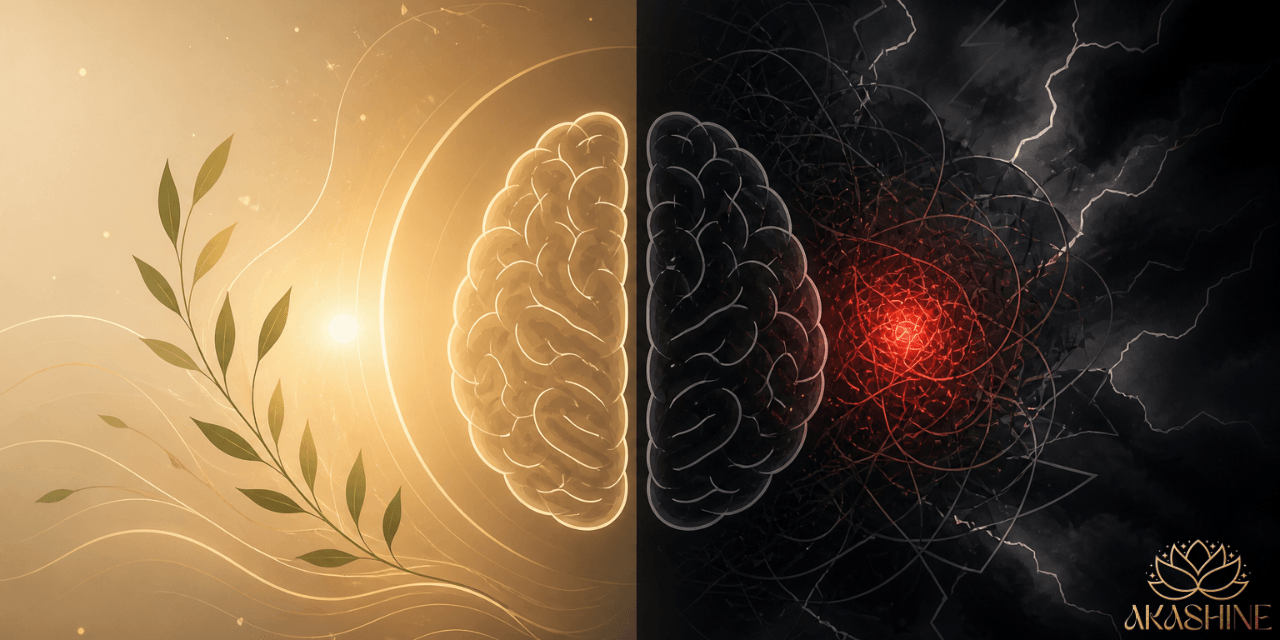
Today I want to talk about something I’ve found very important in my own life, because for a long time I struggled to distinguish between intuition and fear, and I think this is extremely common since both can feel like a strong internal “gut feeling,” both can appear suddenly, and both can strongly influence decisions even when we are not consciously analyzing what is happening in the background.
What changed everything for me was not trying to intellectualize it more, but starting to understand what is actually happening in the brain and nervous system, and then combining that with simple daily observation of my body and mental state in real time.
Why intuition and fear feel so similar
- Both appear as fast internal signals
- Both feel emotionally meaningful in the moment
- Both can feel like “truth” when they arise
- Both influence decision-making quickly
The confusion happens because the brain does not label internal states clearly, so what we experience subjectively is just “a feeling,” even though underneath that feeling there are very different neural processes happening.
The real difference is not the intensity of emotion, but the type of neural activation pattern behind it.
What fear is doing in the brain and body
Fear is primarily linked to the limbic system, especially the amygdala, which acts like a threat detection center constantly scanning the environment for potential danger.
When the amygdala detects something uncertain or potentially risky, it activates the hypothalamus-pituitary-adrenal (HPA) axis, which triggers the release of stress hormones like cortisol and adrenaline.
This leads to a very specific physiological state:
- Increased heart rate (sympathetic nervous system activation)
- Muscle tension and readiness for action
- Faster, more repetitive thought loops
- Narrowing of attention (tunnel vision)
- Increased prediction of negative outcomes
At the brain level, there is also a reduction in flexible reasoning because the system prioritizes survival over reflection, which is why fear often feels urgent and absolute, even when the situation is not objectively dangerous.
In modern life, this system is frequently activated not by physical danger, but by psychological uncertainty, social evaluation, or loss of control, which means the brain reacts as if there is a threat even when there is none.
What intuition is (neuroscience perspective)
Intuition is not mystical, it is closer to subconscious pattern recognition and integrated processing across multiple brain systems.
Instead of being driven by a single threat response like fear, intuition emerges from the interaction between:
- Prefrontal cortex (integration, decision-making, long-term evaluation)
- Insula (interoception, internal body awareness)
- Hippocampus (memory and past experience patterns)
- Distributed cortical networks that process information below conscious awareness
What this means in practical terms is that your brain is constantly collecting far more information than you are aware of, and intuition is often the “summary output” of that hidden processing, which is why it feels like a quiet sense of knowing without needing a full logical explanation.
Physiologically, intuition is usually associated with a more regulated nervous system state, meaning:
- Lower sympathetic activation
- More parasympathetic balance
- Stable breathing patterns
- Less mental noise and narrative escalation
It does not trigger a stress cascade, which is why it feels calm even when it points toward uncertainty.
How I distinguish them in real life (simple system)
In daily life, I don’t try to “figure it out” mentally, I simply observe how my system behaves in real time, especially in three areas:
- Body sensation
- Thought speed and structure
- Sense of pressure or calmness
From there, I identify the quality of the signal rather than the content of the thought.
Fear vs intuition in practice
Fear usually shows up as:
- Activation of tension in the body (muscle contraction, shallow breathing)
- Rapid, looping thought patterns
- Mental simulation of worst-case scenarios (amygdala-driven threat prediction)
- Sense of urgency (“I need to decide now”)
- Narrow focus on potential loss or danger
- Feeling of internal pressure or agitation
This is essentially the sympathetic nervous system in dominance, preparing the body for fight-or-flight even in non-physical situations.
Intuition usually shows up as:
- More neutral or relaxed body state
- Slower, clearer mental processing
- No urgency, even if the decision is important
- Absence of catastrophic storytelling
- Sense of internal coherence without explanation
- Feeling of “rightness” without emotional intensity
This tends to appear when the nervous system is more regulated and the prefrontal cortex is not overridden by threat signaling.
Body-based signal: contraction vs expansion
One of the most reliable ways to distinguish them is through the nervous system state:
- Fear = sympathetic activation → contraction, tension, urgency
- Intuition = regulated integration → expansion, calm clarity, stability
This is not abstract, it is measurable in how your breathing changes, how your muscles respond, and how fast your cognitive processing becomes.
A practical exercise you can apply
- When you feel a strong internal reaction, pause before acting
- Do not immediately respond or decide
- Observe your breathing, body tension, and thought speed for 1–3 minutes
- Notice whether the state escalates or stabilizes over time
- Avoid building mental narratives during this observation
From a neurological perspective, what you are doing here is allowing the amygdala-driven response to settle, so that the prefrontal cortex can re-engage and give you a more integrated perspective.
The key question to ask yourself
Instead of overanalyzing, use a simple filter:
- “Is this signal coming from a threat response system or from a place of integrated clarity?”
Because fear is fundamentally a survival mechanism based on protection and prediction of risk, while intuition is more related to integrated information processing that does not rely on urgency or emotional escalation.
Why this matters in everyday decisions
The goal is not to eliminate fear, because fear is essential for survival and biological protection, but to stop confusing it with intuition in situations where there is no real immediate danger, and to start recognizing that intuition is often the result of a more regulated nervous system and deeper subconscious processing, which becomes easier to access when you reduce internal noise, slow down your reactions, and learn to observe your own physiological state instead of automatically acting on it.