
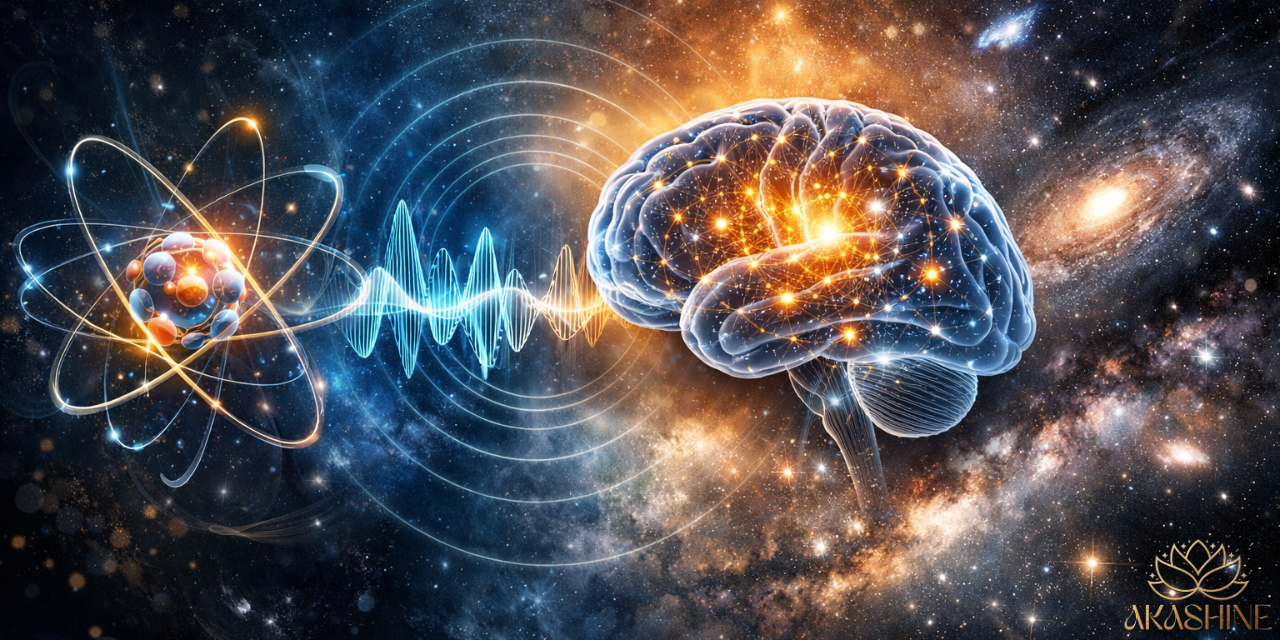
Introduction: the invisible world of sound
Right now, as you read these words, the world around you is vibrating.
The air in the room is in constant motion, molecules colliding and separating billions of times every second. The ground beneath your feet carries subtle oscillations from distant movements. Even the cells inside your body are alive with microscopic vibrations as molecules interact, proteins fold, and neurons fire.
Yet most of these movements pass completely unnoticed.
What we call sound is only a tiny window into this vast ocean of vibration. It is the small fraction of mechanical waves that our ears have evolved to detect. Beyond that narrow band lies a much larger world of oscillations that shape matter, influence biological systems, and even played a role in the formation of the universe itself.
From the smallest quantum fields to the large-scale structure of galaxies, patterns of vibration appear again and again throughout nature.
To understand sound, therefore, is not simply to understand hearing. It is to explore one of the most fundamental ways energy moves through the fabric of reality.
And once we begin to follow that thread—from atoms to neurons, from the human body to the earliest moments of the cosmos—sound reveals itself as something far more profound than a sensory experience.
It becomes a doorway into the dynamic architecture of the universe.
The quantum foundation: a universe built from vibration
Modern physics has revealed something remarkable: the universe is not made of solid objects in the way our senses suggest.
At the most fundamental level, reality is composed of fields that constantly fluctuate and vibrate. Quantum field theory describes every particle as an excitation within an underlying field that permeates space.
An electron, for example, is not a tiny solid sphere. It can be understood as a localized oscillation in the electron field. In a similar way, the particles inside atomic nuclei arise from deeper interactions between quantum fields.
Matter, therefore, is not static substance but organized vibration.
Although sound as we usually define it requires a medium such as air, water, or solid materials, the deeper principle behind sound—oscillation—appears throughout the very fabric of physical reality.
From vibration to sound waves
Sound begins when an object vibrates.
When a tuning fork, a vocal cord, or a guitar string moves back and forth, it pushes against the molecules surrounding it. These molecules then collide with neighboring molecules, transferring motion outward in a chain reaction.
What travels through the medium is not the matter itself but a pattern of pressure changes moving through it.
Physicists call this phenomenon a mechanical wave.
Every sound wave can be described by two fundamental properties.
Frequency refers to how many times a vibration repeats each second and is measured in Hertz. Higher frequencies correspond to higher-pitched sounds.
Amplitude refers to the strength of the vibration and determines how loud the sound is.
The human ear can typically detect frequencies between 20 Hz and 20,000 Hz, but vibrations exist far beyond this range. Many oscillations occur continuously in the environment without ever reaching our conscious perception.
Sound, in other words, represents only a small fragment of the vibrational activity around us.
The human body as a vibrational system
The human body itself is deeply connected to vibration.
Approximately sixty to seventy percent of the body consists of water, which is an excellent conductor of mechanical waves. Because of this, sound can travel not only through air but also through tissues, fluids, and bones.
The nervous system processes these vibrations in several ways.
Inside the inner ear, the cochlea contains thousands of microscopic hair cells that respond to specific frequencies. When sound waves enter the ear, these cells convert mechanical vibrations into electrical signals that travel to the brain.
At the same time, the body contains mechanoreceptors in the skin that can detect pressure and vibration. Low-frequency oscillations can therefore be perceived through touch as well as hearing.
The vestibular system, responsible for balance and spatial orientation, also responds to mechanical movement and vibration.
These mechanisms reveal that sound is not only something we hear; it is a physical interaction between waves of motion and biological structures.
Neuroscience: how the brain interprets sound
Once vibrations reach the inner ear, they are converted into neural signals and transmitted through the auditory nerve to the brain.
The brain then performs complex processing. It analyzes frequency patterns, rhythm, spatial information, and harmonic relationships. From these signals, neural networks construct the auditory experience we perceive as voices, music, or environmental sounds.
Sound also interacts with regions of the brain involved in emotion and physiological regulation.
Research in neuroscience shows that auditory stimuli can influence heart rate, breathing patterns, and emotional states. This is partly because sound interacts with the limbic system, which plays a key role in emotion and memory, as well as with networks that regulate the autonomic nervous system.
Rhythmic and harmonic patterns of sound can therefore interact with the neural circuits that shape attention, relaxation, and perception.
Cosmology: the ancient sound of the universe
The influence of vibration is not limited to living systems. It also appears in the structure of the universe itself.
Cosmologists studying the early universe have discovered that shortly after the Big Bang, the primordial plasma filling space experienced pressure waves similar to acoustic oscillations. These waves traveled through the dense matter of the young cosmos.
Although the conditions were very different from the air around us today, the physics behind these oscillations is closely related to the behavior of sound waves.
These ancient waves left measurable imprints in the cosmic microwave background radiation and in the distribution of galaxies across the universe. Scientists refer to these patterns as baryon acoustic oscillations.
In a very real sense, the large-scale structure of the universe still carries traces of these primordial vibrations.
Could the universe itself be vibration?
As physics has progressed, a surprising idea has appeared in multiple areas of research: vibration may be a fundamental feature of reality itself.
Particles can be understood as oscillations of quantum fields. Gravitational waves—ripples in the fabric of spacetime—can travel across the universe when massive cosmic events such as black hole collisions occur.
Some theoretical frameworks, such as string theory, even propose that the most fundamental components of nature might be incredibly small vibrating strings. In this picture, different particles would correspond to different vibrational modes of these strings.
Although some of these theories remain under investigation, they highlight a fascinating possibility: the properties of matter may ultimately depend on patterns of vibration.
Across scales ranging from quantum physics to cosmology, oscillation repeatedly appears as a central principle.
Where science meets human experience
Understanding sound scientifically does not remove its sense of wonder. Instead, it reveals how extraordinary the ordinary can be.
Every sound we hear is the result of a chain of events that begins with microscopic motion, travels through matter as waves, interacts with biological systems, and is finally interpreted by the brain as conscious experience.
The same universe that produces galaxies, atoms, and living organisms also produces vibration, and sound is one of the ways those vibrations become perceptible to us.
Throughout history, many cultures have intuitively sensed this connection between vibration and existence. Music, rhythm, chanting, and resonance have long played central roles in human life.
Science does not frame sound as mystical energy or supernatural force. What it reveals is something equally fascinating: vibration is woven into the structure of matter, the functioning of biological systems, and the evolution of the cosmos.
When we begin to see sound through this perspective, listening becomes something deeper than hearing.
It becomes a way of encountering the dynamic nature of reality itself.