
When the Earth Begins to Reappear
Good beginning of the week. I hope you are well.
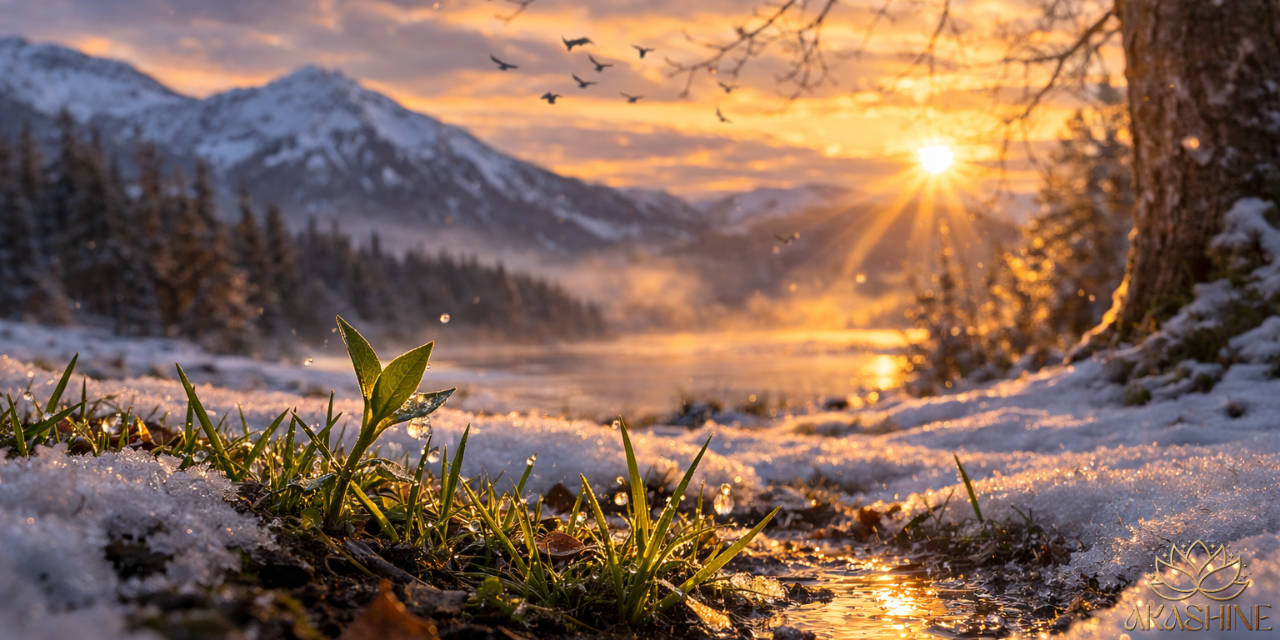
Today, while taking my dog outside, I felt a quiet sense of excitement because the ground is finally beginning to appear again. After months of snow, small patches of grass are starting to reveal themselves, and seeing that green return after such a long winter filled me with a simple but genuine joy. The grass looked deeply nourished and humid, almost as if the earth itself had been slowly breathing beneath the snow during these months, gathering strength in silence.
It reminded me of the sensation of waking slowly from a long dream, when the body gradually returns to life after a deep rest. Although I do not see winter as rest in the literal sense, I have always felt that winter carries a deeply introspective quality, because many movements are taking place beneath the surface that cannot yet be seen from the outside. There is a quiet form of creation happening during this time, a kind of silent preparation that reminds us that life rarely stops, even when everything appears still.
This reflection led me to think about the constant movement in which we live.
Even when things appear quiet, life is always moving in deeper ways.
Stillness Does Not Mean the Absence of Movement
Nature constantly reminds us that what appears still on the surface often hides profound processes taking place underneath. Seeds are preparing themselves in the soil, the ground reorganizes its internal balance, and ecosystems slowly adapt to the conditions that will eventually allow life to emerge again. The apparent stillness of winter is therefore not a pause in life, but rather a phase in which life gathers its energy inward.
This understanding is not only present in nature, but also in many spiritual traditions.
In Taoist philosophy, reality is described through the dynamic balance between yin and yang, where yang represents movement, activity, and outward expression, while yin represents receptivity, stillness, and inward gathering. Winter can therefore be understood as a deeply yin phase of existence, a moment in which energy withdraws into itself before expanding again through the vitality of spring.
Similarly, in Buddhist traditions of meditation, stillness is not seen as inactivity but as a fertile ground where awareness becomes clearer and deeper. When the surface of the mind becomes calm, much like a lake whose waters stop being disturbed by the wind, deeper layers of perception can begin to appear naturally.
Even ancient cultures understood this rhythm of hidden transformation. In Egyptian symbolism, the scarab represented rebirth emerging from unseen processes, reminding us that what appears silent or inactive may in reality be preparing a profound renewal.
The Challenge of Balance in the Modern World
Observing the grass returning after the winter snow made me think about the rhythm of modern life and how disconnected we sometimes feel from these natural cycles.
Today we live in a world where movement is expected to be constant and visible. Productivity, achievement, and progress are often measured through what can be externally observed, which creates the impression that if nothing visible is happening then nothing valuable is occurring. Yet nature constantly shows us the opposite: some of the most important transformations happen quietly and without spectacle.
A simple example can be found in work.
If we work continuously without pause, sooner or later imbalance appears. At first it may manifest subtly, perhaps through fatigue, irritability, or difficulty concentrating, but over time these signals become clearer reminders that the system has lost its equilibrium. For balance to exist, movement must always be accompanied by rest, just as activity in nature is always followed by periods of regeneration.
The more polarized we become toward constant activity, the more imbalance we create within our lives.
This is something that took me many years to understand, and I recognize that even today it remains something I continue working on.
Learning to Recreate Balance
We are living in a generation where creating balance may be more important than ever before. Everything moves faster, information flows constantly, and there is more stimulation surrounding us than at any other moment in human history. In such an environment, learning to create space for stillness is not simply a lifestyle choice but almost a necessity for maintaining psychological and emotional equilibrium.
Yet choosing balance often requires small acts of resistance.
Sometimes the easiest path is simply to continue scrolling, consuming information, and responding to every impulse that appears. Saying no, even to something seemingly small, requires a certain degree of awareness and intention.
For me, balance often begins with very simple practices.
One of the things I try to do is limit my time on social media. Some days this comes naturally, while on other days I notice how easy it is to fall back into the same patterns of constant stimulation. Still, I try to maintain the intention, not with rigidity or self-judgment, but simply with the awareness that balance is something that must be cultivated again and again.
Nature reminds us constantly that life unfolds through cycles.
There are times for growth, times for action, and times for stillness. None of these phases are more important than the others, because each one prepares the conditions for the next.
Perhaps the grass beneath the snow understands this better than we do. For months it remains hidden, quietly preparing itself without showing any visible sign of activity, yet when the conditions become right it emerges again stronger and more alive, nourished by the silence that preceded it.
Maybe balance in our lives works in a similar way.
Sometimes the most meaningful transformation is not the one that can immediately be seen, but the one quietly unfolding beneath the surface.